Tetsuo HARADA l artist
home l arts l events l publications l medias l teaching l biography l links l contacts l map l search
book + catalogs + texts + >> order
catalog Harada  
 

tetsuo harada


tetsuo harada tetsuoharada.comtetsuoharada.comtetsuoharada.com
tetsuoharada.comtetsuoharada.comtetsuoharada.comtetsuoharada.com

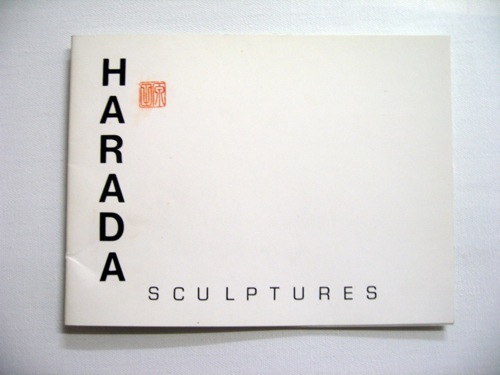
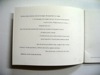
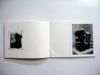
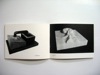
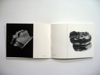
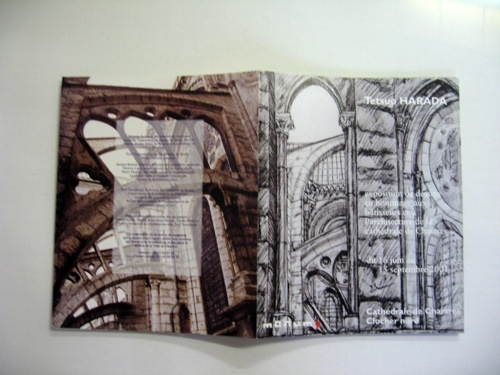
20 pages, 22x16,5cm, in french, black/white 17 illustrations, edited by the gallery Pierre Lescot 75001 Paris les Halles, Libeth Foissac and Michele Coche. Harada personnal exhibition - january 16th to February 16th 1982.

1982

Texte de Tetsuo Harada :

Cet été, j'étais à Carrare, dans la montagne. Brusquement un nuage...

Il m'enveloppa, me coupant de tout. Un autre monde semblait
s'ouvrir à moi. N'était-ce qu'une illusion... ?

J'avançais sans voir.

Sous mes semelles je sentais des rochers qui sortaient et piquaient la terre.

Je restais surpris, amusé.

... Toucher de mes mains cette manière m'aurait sans
doute rassuré et l'illusion serait devenue réalité.

Sans doute dois-je préférer rêver, imaginer des mondes
inconnus : fonds sous-marins, intérieur de la terre, espace cosmique.

Sans doute aussi, ce rêve que mes mains manipule, anime toutes ces formes.


Titres des sculptures présentées à la galerie Pierre Lescot :

SECRET CONNU DE TOUS

PIEGE

IMMERSION

ÉPANCHEMENT

EFFUSION

IRRUPTION

IRRUPTION/PENETRATION

Catalog HARADA  
 

tetsuo harada


tetsuoharada


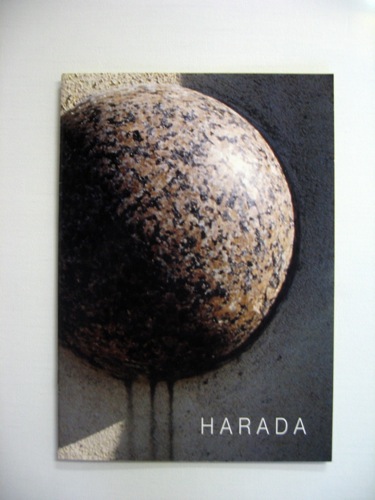
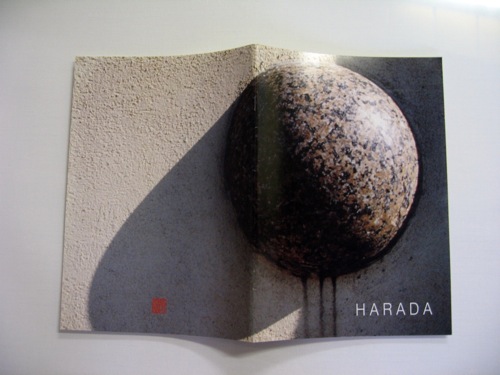
20 pages,A4, 21x29cm, 24 illustrations, edited by the artist,
FRANCAIS, JAPONAIS, ANGLAIS
8 Euros / 800 JPY / 8 US$ / 8 UK£

buy, order directly Harada atelier + 33 1 43 38 05 15

1973 - 1990

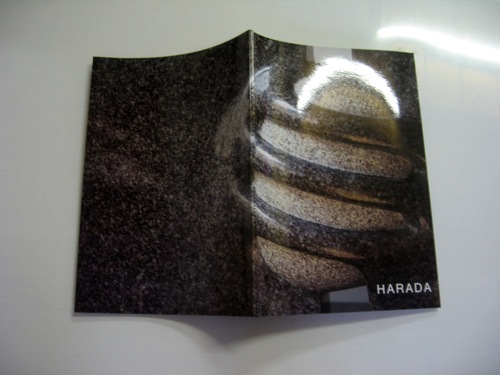
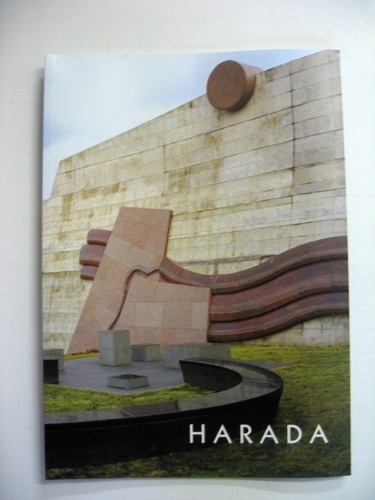
"HARADA", my Catalog number one was published in 1990, catalog a very rich yet simple synthesis of my work from 1973 to 1990. you will find my monumental sculptures. Orders are public and private commissions.

"HARADA", 原田, 私のカタログ番号1は1990年に公開されて. 1990年から1973年からカタログ私の仕事の非常に豊かなシンプルな合成。あなたが私の記念碑的な彫刻を見つける. ご注文は公開され、民間委託。 形式A4サイズ、20ページの4倍。

"HARADA", mon catalogue numéro 1 est publié en 1990, c'est une synthése très riche et synthétique de mon oeuvre de 1973 à 1990. Vous trouverez principalement des sculptures monumentales installées dans des places publiques ou privées.

The preface is written by the poet Maurice Bourg :
If I had to describe the work of Tetsuo Harada, I would mention the power he has of going beyond appearances to reveal the profound truth of forms. Whether in granite, marble, albaster or wood and bronze;
sometimes he uses the interplay of hard, sharp-ridged geometrical figures and smooth, softly-curved surfaces, all for the greater delight if the reflective spirit, creating sculptures which are precious objetcs to be enjoyed indoors.
Or else rise up his monumental sculptures, his fountains...
But always with that knack of fitting then into the urban environment, which they magnify and render human, a standing invitation to passers-by to stop for a while ub silent contemplation.
Tetsuo Harada's work testifies to his desire to break down the limits of the everyday, to reach out the part of Man where the invisible becomes visible. Who would not wish to share with the artist this landscape within us where we can find the harmony of opposites, unexpected encounters between megaliths ans shingle, between lunar horizons and the soft warmth of Mother Earth.

Le texte d'introduction est du poète Maurice Bourg :
S'il me fallait qualifier l'oeuvre de tetsuo Harada, j'évoquerais son pouvoir de dévoiler le vérité profonde des formes par delà l'apparence.
Que ce soit avec le granit, le marbre, l'albâtre ou le bois et le bronze.
Tantôt alliant des figures géométriques aux arêtes dures, coupantes, avec un jeu de surfaces planes, aux douces rondeurs, et cela pour le plus grand plaisir de l'esprit méditatif, qui fait de ces sculptures de précieux objets d'intérieur.
Tantôt dressant ses sculptures monumentales, ses fontaines...
Mais toujours avec ce savoir de l'insertion dans l'environnement urbain qu'elles magnifient et humanisent. Initiation permanente au passant de s'arrêter quelques instants en un silence contemplatif.

_______________________________________________

The orient and the west, where Tetsuo Harada lives. A crucible of ideas, a giving ans taking. A fertile soil where his edeas can bear fruit. Harmony, melody, rhythm, he expresses himself like a musician in a symphony of noble materials which defy time.
tetsuo Harada's work draws us into his own private world.
Tetsuo Harada's work draws us into his own private world.
He shares with us its cosmic and earthly dimensions; we who look on, take part in his work may be creatures of flesh and blood, but we constitute its essential soul.
Hubert d'Herceville, Journalist

L'Orient et l'Occident où Tetsuo Harada vit, creuset des idées et des échanges.
Cette terre riche fait éclore ses idées, Harmonie, mélodie, rythme, tout comme un musicien il s'exprime en symphonie avec des matériaux nobles défiant le temps. Par sa culture, l'oeuvre de Tetsuo Harada nous fait vivre son monde à lui.
Il nous fait partager les dimensions du cosmique et du tellurique.
Ses spectateurs et ses acteurs restent des hommes, mieux ils en composent l'âme indissociable.
Hubert d'Herceville, Journaliste


catalog HARADA  
 
tetsuo harada

tetsuo harada

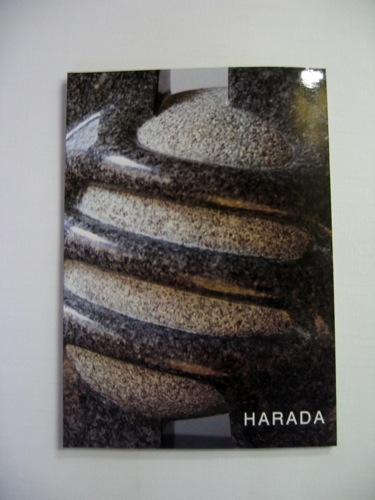
40 pages,A4, 21x29cm, 45 illustrations, edited by the artist in 1994,
FRANCAIS, JAPONAIS, ANGLAIS
8 Euros / 800 JPY / 8 US$ / 8 UK£

buy, order directly Harada atelier + 33 1 43 38 05 15

1994  

L'UNION

LA PAIX

L'HOMME

LA NATURE

UNION

PEACE

MAN

NATURE

Le Tricot de la Terre Earth Weaving


HARADA, my Catalog Earth Weaving is the second number. He published it in 1994, catalog a very rich yet simple synthesis of my work from 1990 to 1994. you will find my monumental sculptures and galery sculptures, paintings, drawings, bronzes.

EARTH WEAVING
By Tetsuo Harada


My sculptures are created not only as beautiful objects in themselves. My motivation is to transmit the message of Peace, Union and love.
I am in Pietrasanta Italy, where Michael Angelo worked. I try to understand on a deep level the meaning of his sculpture. In David, he wished to transmit a message of youth and beauty; in the Pieta a message of Love and in the Slave a mesage of force and liberty. As well as Michael Angelo, i am communicating my artistic sensibility.
“Le tricot de la terre” “Earth weaving” is a group of sculptures whick covers the world. “Earth weaving” creates mo,ls which will nourish ans unite it. The “stitching logether” symbolizes a desire for a dialogue of Peace, Union and LOve in order to reunite Men, the public and the continents. The more that I travel, the more I wish to serve the Earth, to protect the Earth and to give emphasis to the fondamental values of man.

LE TRICOT DE LA TERRE
Par Tetsuo Harada

Mes sculptures ne sont pas uniquement des objets de décoration.
Ma motivation est de transmettre un message de Paix, d’Union et d’Amour.
Je suis à Pietrasanta où Michel Ange a travaillé. Je médite sur ses sculptures. Dans David il souhaitait transmettre un message de jeunesse et de beauté, dans la Piéta un message d'amour et dans l'Esclave un message de force et de liberté. De même que Michel Ange, je communique ma sensibilité artistique.
Le Tricot de la terre est un ensemble de sculptures qui couvre le monde
“le tricot de la terre” fait de boucles et de liens traverse la planète, la nourrit et l’unifie. Les mailles symbolisent la volonté de dialogue de Paix, d’Union et d’Amour tissées afin de réunir les hommes, les peuples et le continents.

Titres des sculptures du catalogue 2:

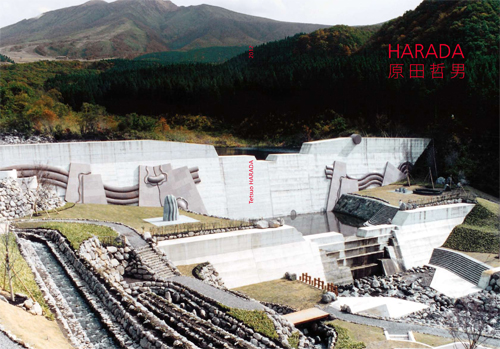
Sculptures monumentales conçues et sculptées installées par Tetsuo Harada lui-même : L'age de pierre. La sculpture Barrage 1984 de Tazawako, près de Akita au Japoon. La main protectrice 1994 à l'hopital Katsuhiraen à Akita au Japon. Le Muscle 1994 à Tokyo Athelic Club quartier de Nakano dans Tokyo. Monument au 38eme parallele 1992 à Kajigawa, Niigata au Japon. La Grande Terre 1191 chez Kawasaki à Shibata Niigata au Japon. Le jardin minéral 1989 pour l'Hôtel des impôts à Saint Brieuc en bretagne. Les quatres saisons 1993 au Jardin des plantes de Niitsu Niigata au Japon. Le Tricot de la Terre 1993 à Lanhélin en Bretagne.Le Fleuve 1990 Kyowa Akita au Japon.

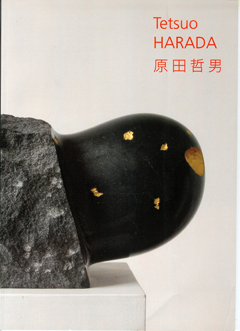
Petites sculptures : Effusion 1982. Secret connu de tous 1981. L'Anneau 1992.

catalog HARADA  
 

tetsuo harada


tetsuo harada

1994 - 2000

HARADA, ENVIRONMENT-ART
AN ART OF UNION AND RELATION
To try and grasp architecture or sculpture simply through shapes would not lead to a clear understanding of the meaning and the sensation they convey : it would amount to forget, on the one hand, that the empty space has a meaning and on the other hand, that the meaning not only lies in space as such, but also in its occupancy, in the relations that emanate from it.
Shape, space, relation : an environment.

Though it speaks to the senses, and sometimes to sensuality in its most carnal dimension, it is above all the primal meaning that Harada's work pursues, a meaning that finds its source in the imaginary of creation, in a literal meaning : union, fold, interweaving, mating, birth. A creation appearing on the edges, the lips, in the intervening space.
UNION         
The work of Harada is about shapes but mainly connections, relations. A whole art of relation that disarms the apparent dialectic of his production between simplicity and complexity. The creative act turns over itself like a glove, and questions about its birth, pointing at the immanence and the fundamental tautology of creation.
Harada declines this theme at various levels :
-the union between artwork and nature or city,
-the union between artwork and the beings,
-the friendship of people, from the fusion of feelings to the fusion of cultures.
A long list of countries attest to this cosmopolitism : Japan, France, but also Italy, Spain, Germany, Denmark, Holland, Israel, the United States, India... but also, among hundreds, regions and landscapes : Toscany, Brittany, the Ardennes, the Beauce... or cities : Saint-Malo, Paris, Pietrasanta, Niitsu, Tokyo, Leiden...
INTERBREEDING         
From this human and geographical development, from his own family, beautifuly mix-raced, from his itinerary made of teaching and sharing, Harada builds up the arguments of an initiatory route :
-a life and a work of art like a metaphor in progress, convening in curious alchemy the union of art and the forms of union,
-a path of sympathy with the world and the things as well as the beings, that probably is ' environment-art '. Though this path indeniably and essentially belongs to sculpture, it carries along close ties with landscape art, architecture and urbanism.
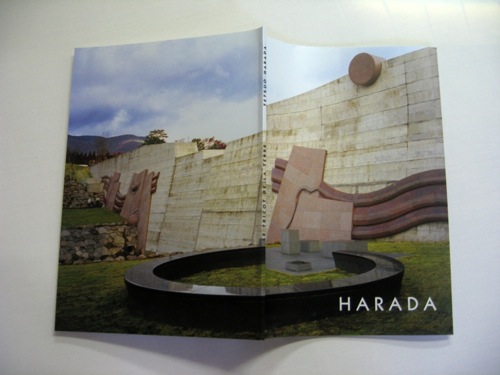
One of Harada's adventure is particularly representaive of this aspect of his work : the cycle of the 'earth weaving', a huge and protean sculpture supposed to traverse the globe and spring up from the earth bringing a message of peace; its most spectacular emergence is the Tazawako dam in Japan.
HOSPITALITY         
But to try and feel Harada's personality, as well as the two hundred tons of granite of Tazawako, one would eventually have to mention all the people that approached him, or followed him in his teaching or in the adventure of the construction of his atelier in Frenay-l'Evêque. They have seen the quality of his welcome, his humble and insatiable curiosity, this other art of relation, hospitality, which is a foundation of his art, much more than a 'simple' practice, which he undoubtedly fully possesses.

TETSUO INTIMIST
Whether it be through his big environment-sculptures or through smaller pieces, Harada's artwork involves the public and invites it to participate in a more confidential and even intimate encounter.
FOAMING
In the intimacy of his atelier, away from the collective execution of big environment-sculpture projects, Harada draws, shapes, curves, models and moulds small dimension works. These artworks show unceasing returns, reflexion, dissatisfaction, research, constituting the time and the milestones of a route and of an intrigue fostered in the heart of the atelier, sometimes a peaceful moment after a construction work or a class, somtimes a moment of ' foaming ', a new find that might blossom and meet its public, its environment.
DIVERSITY
There are of course, three-dimensional artworks : proper sculptures made out of bronze, wood, marble, granite or sometimes a simple pebble, differing from monumental sculptures by its small scale. There are also the roughs (research and studies, either with no goal, or for a project or a competition) made from clay or plaster, that prefigurate big sculptures.
And there are drawings and paintings. He works on each of those as a sculptor, deserting the easel for the drawing table or the sketchbook, that never leaves him : vigorous hatchings shape his drawings with large expanses of light and shadow, often revealing a relief and a strong volume. His paintings are adorned with raw material like metal dust, gold, silver, bronze or cobalt, that he dilutes with water and fixes, or with bright color pastels that look like pigment crushed on paper.
MULTIPLICITY
In short, Harada's atelier forms a world gathering a fauna of small paper or stone beings, of great diversity but always born out of the same hand. Every work has a sensual, carnal character, not only through gentle curves, smooth shapes and soft material, but above all through the setting of an imaginary world more or less blatantly erotic, where figures blossom and unveil themselves, hide, unite, bind and interweave in the most various ways.
PUBLIC / PRIVATE
Just like environment-sculptures, the spectator is led to participate : if he cannot physically walk through a sculptural space as it is the case in monumental sculptures, he is this time the guest and the actor of an encounter of a more private kind...
Hubert Lempereur Architect

INTRODUCTION

Depuis le dernier catalogue de 1995, j'ai réalisé un certain nombre de nouvelles sculptures que je voudrais vous présenter dans ce troisième catalogue.
Avant tout, je remercie sincèrement toutes les personnes qui m'ont donné la chance de réaliser ces sculptures. Ce que je suis aujourd'hui, je le dois à la compréhension et à la coopération de nombreuses personnes, à l'influence des grands artistes, et à mon entourage dont ma femme Annie et mes deux fils qui m'ont toujours soutenu.

La sculpture sur pierre est un exercice difficile et très physique. La pierre est lourde, elle est dure. Dans mes réalisations monumentales, le résultat final est quelquefois un peu différent de ce que j'avais rêvé. Alors j'utilise plusieurs moyens d'expression, je continue à peindre, à dessiner et à faire de petites sculptures pour traduire mes idées plus simplement. Cela me donne beaucoup de plaisir, de même que d'exposer mon travail en public.

J'ai eu la chance de travailler dans les pays nordiques, j'ai apprécié la gentillesse, le calme et la sensibilité des gens de ces pays. Cela me rappelle la nécessité et l'importance du voyage. Il est source de nouvelles amitiés et de découvertes culturelles. J'ai beaucoup appris en communiquant et en vivant dans d'autres cultures. Je pense qu'il nous reste encore d'énormes progrès à faire dans le domaine des échanges culturels, qui pour moi sont vecteurs d'amitié et de paix. Les hommes ressentent des sentiments variés de joie, de tristesse, d'amour, de haine et de vanité. La musique, la danse, la sculpture, la peinture sont des créations auxquelles chacun peut-être sensible : je crois que l'art nous procure un plaisir qui nous fait dépasser ces sentiments et atteindre une certaine plénitude.

Dans ma sculpture, je travaille aussi le bois et le bronze mais la puissance, la présence et la délicatesse de la pierre me fascinent depuis toujours. A travers elle, je ressens le temps à l'échelle terrestre. Sculpter la pierre est un honneur et une expérience très touchante; la nature mérite qu'on lui rende hommage.

J'ai cinquante ans, ma réflexion mûrit et j'ai encore beaucoup à dire et à sculpter. Aujourd'hui, je tiens à développer mon thème du " tricot de la terre ". Pour cela, j'ai besoin de votre compréhension et de votre soutient. Je suis très heureux de vous présenter mes récents travaux dans ce catalogue.